
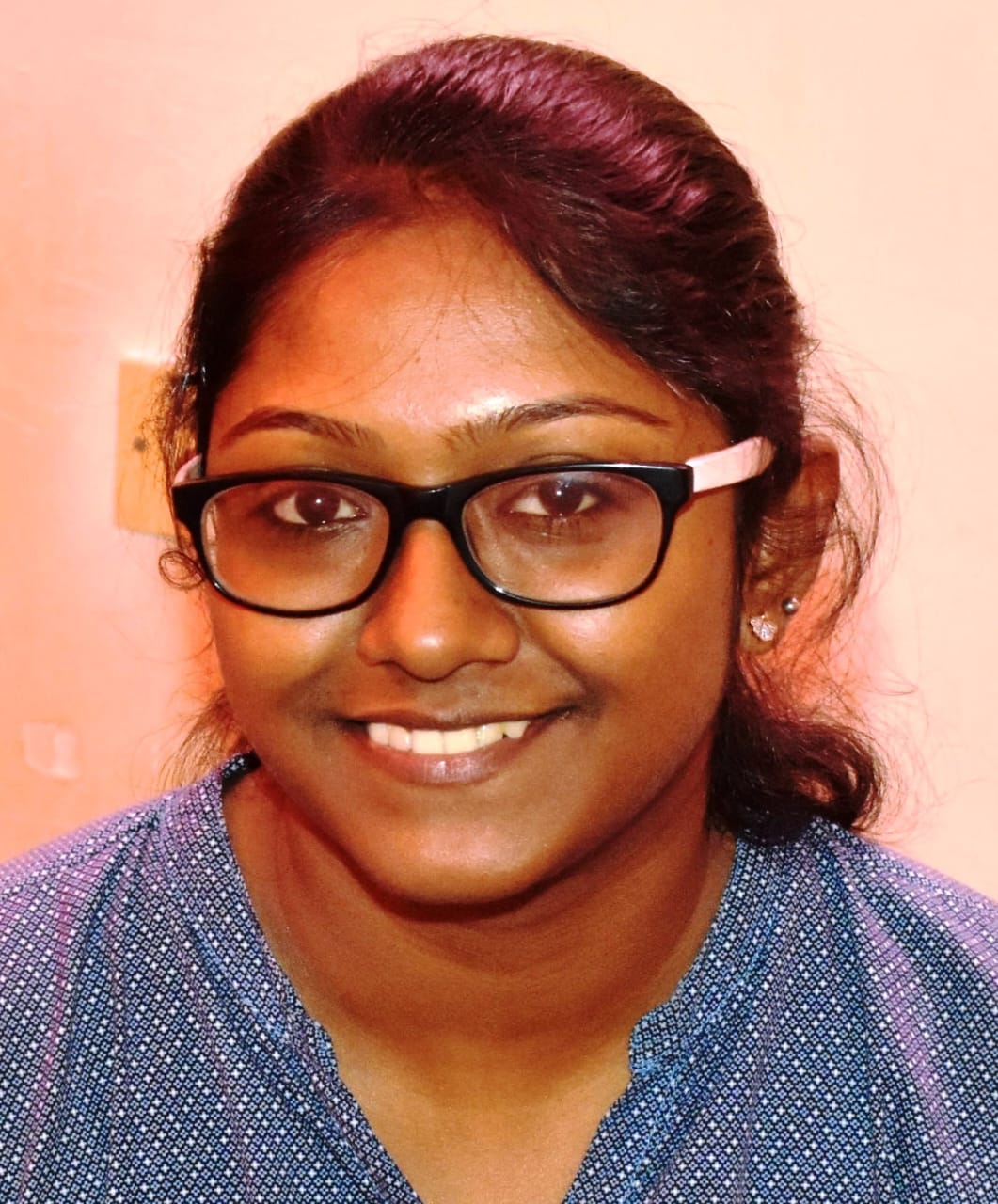
Dr. Kasturi Barik
Faculties: HOD, Centre For Data Science
Assistant Professor
About :
Dr. Kasturi Barik is an applied machine learning researcher with a strong passion for neuro-signal processing, cognitive neuroscience, and biomedical signal processing. Her expertise spans the complete neuro-signal processing pipeline, including data acquisition, pre-processing, feature extraction and selection, statistical analysis, and classification. She has published research in peer-reviewed journals, demonstrating strong research potential and academic rigor. She is prepared to explore new domains and address challenging healthcare problems. Her participation in the Smart India Hackathon and her role as Vice-Chair of the IEEE Signal Processing Society Student Branch at IIT Kharagpur reflect her strong team spirit as well as proven leadership abilities.
Research Interest :
Neuro-signal processing, Machine learning, Bio-medical signal, Statistical methods, Pattern recognition, Digital Signal Processing, Deep learning, Cognitive neuroscience, Artificial Intelligence in Healthcare
Summary of Research Activities
- Acquired domain knowledge of physiology of neuro-signals and manifestation of Autism in them.
- To study and analyze how the underlying neural mechanisms of autistic children differ from normal children using MEG signals based on machine learning framework.
- Proposed a novel phase-based spectral domain feature which performed better than power spectral density based feature to identify autistic children, using a pattern classification approach.
- Using the complementary characteristics of power and phase based feature, fusion based model is analyzed in the autism detection.
- To identify the possible cortical spatial pattern behind the autism spectral disorder, we have introduced common spatial patter based machine learning approach for autism detection in young children.
- Introduced envelop of imaginary coherence and proposed envelop of complex coherency functional connectivity analysis using complex coherency based features to understand the interactions between different brain regions of a neural system.
Technical Skills :
- Programming Skills: MATLAB, Python, Java
- Libraries and Tools Explored: Scikit, Numpy, TensorFlow, Keras, Excel, EEGLAB, Fieldtrip, LIBSVM
Awards, Scholarships and Extra Curricular Activities :
- Awarded GATE fellowship from Ministry of HRD, Govt. of India for M.Tech (May 2013- November 2013).
- Reviewer of Medical & Biological Engineering & Computing (MBEC), Springer.
- Reviewer of Frontiers in Psychiatry, Frontiers.
- Served as Vice Chair of IEEE Signal Processing Society, Student Branch Chapter, IIT Kharagpur (2021 tenure).
- Served as Treasurer of IEEE Signal Processing Society, Student Branch Chapter, IIT Kharagpur (2020 tenure).
- Dramatics; Member of IIT Kharagpur bengali drama club’Boikalik’.Played lead and side role at ’Boikalik’.
- Regular participant and winner in Recitation competitions (District Level).
- Regular participant and winner in Drawing & Arts competitions (School & Block Level).
Relevant Projects :
- GadgetsGhatao: Developing Neurosignal Biomarkers to Combat Screen Addiction
- Aim: To develop standardized EEG biomarkers to diagnose and monitor screen addiction, particularly in children exhibiting pseudo-autistic traits. This framework will enhance the assessment of screen usage patterns and their neurological impacts, supporting early recognition of screen addiction disorder (SAD) to better tailor children’s environments for healthy
Tools: MATLAB, EEGLAB, Fieldtrip, Python
Term-Project organized by Neural Network and Applications Course, held at IIT Kharagpur.
- Problem Statement To diagnose the extent of OCD – Low High – in patients, from their ongoing brain activity (EEG) using a machine learning framework.
- Proposed a novel neural network modelling approach for differentiating low and high OCD participants using EEG signals in both ANN and deep neural networks (DNN).
Tools: MATLAB, Python, EEGLAB
- Proposed a novel understanding of EEG-based mental states decoding approach for face pareidolia, followed by single-trial classification of brain
- The interpretation is that the prestimulus brain activity is clearly conditioning of perception because the stimuli presented were actually noise to the subject’s
Tools: MATLAB, EEGLAB, LIBSVM
Journal :
- Barik, K., Daimi, S. N., Jones, R., Bhattacharya, J., and Saha, G., 2019. "A machine learning approach to predict perceptual decisions: an insight into face pareidolia". Brain Informatics, 6 (1), pp.1-16. SpringerOpen.
- Barik, K., Watanabe, K., Bhattacharya, J. and Saha, G., 2022. A fusion-based machine learning approach for autism detection in young children using magnetoencephalography signals. Journal of Autism and Developmental Disorders, pp.1-19.
- Barik, K., Watanabe, K., Bhattacharya, J. and Saha, G., 2023. Functional connectivity based machine learning approach for autism detection in young children using MEG signals. Journal of Neural Engineering.
- Barik, K., Dey, S., Watanabe, K., Hirosawa, T., Yoshimura, Y., Kikuchi, M., Bhattacharya, J., Saha, G., 2024. Self-Supervised Machine Learning Approach for Autism Detection in Young Children Using MEG Signals. Biomedical Signal Processing and Control.
- Barik, K., Daimi, S. N., Jones, R., Bhattacharya, J., and Saha, G., 2019. "A machine learning approach to predict perceptual decisions: an insight into face pareidolia". Brain Informatics, 6 (1), pp.1-16. SpringerOpen.
- Barik, K., Watanabe, K., Bhattacharya, J. and Saha, G., 2022. A fusion-based machine learning approach for autism detection in young children using magnetoencephalography signals. Journal of Autism and Developmental Disorders, pp.1-19.
- Barik, K., Watanabe, K., Bhattacharya, J. and Saha, G., 2023. Functional connectivity based machine learning approach for autism detection in young children using MEG signals. Journal of Neural Engineering.
- Barik, K., Dey, S., Watanabe, K., Hirosawa, T., Yoshimura, Y., Kikuchi, M., Bhattacharya, J., Saha, G., 2024. Self-Supervised Machine Learning Approach for Autism Detection in Young Children Using MEG Signals. Biomedical Signal Processing and Control.
Conference :
- Barik, K., Watanabe, K., Bhattacharya, J., and Saha, G., 2020, "Classification of autism in young children by phase angle clustering in magnetoencephalogram signals". In 2020 Twenty Sixth National Conference on Communications (NCC), IIT Kharagpur, India, 21-23 February, (pp. 1-6). IEEE.
- Barik, K., Jones, R., Bhattacharya, J., and Saha, G., 2019, “Investigating the Influence of Prior Expectation in Face Pareidolia using Spatial Pattern". International Conference on Machine Intelligence and Signal Processing (MISP), IIT Indore, India, (pp. 437-451). Machine Intelligence and Signal Analysis, Springer.
- Barik, K., Daimi, S. N., Jones, R., Saha, G., and Bhattacharya, J., 2017, “Seeing faces in noise: Predicting perceptual decision by prestimulus brain oscillations”. International Workshop on Brain Dynamics on Multiple Scales, Dresden, Germany, 19-23 June, (Poster).
- Barik, K., Watanabe, K., Hirosawa, T., Yoshimura, Y., Kikuchi, M., Bhattacharya, J., and Saha, G., 2023, “Autism detection in Children using Common Spatial Patterns of MEG signals”. In 45th IEEE Engineering in Medicine & Biology Society (EMBC), pp. 1-4. Sydney, Australia, 24-28 July 2023.
- Saha, U., Barik, K., De, A., 2023, “Fusion of Spectral and Connectivity Features to Detect Depressive Disorder using EEG Signals”. In 3rd IEEE Conference on Applied Signal Processing (ASPCON), West Bengal, India, 25-26 November 2023.
Certification :
Methods & Techniques in Cognitive & Clinical Neuroscience (ISWT)
Brain Rhythyms: Understanding, Measurement, Analysis & Applications (GIAN)
Introduction to TensorFlow for AI, Machine Learning & Deep Learning.