JIS Institute of Advanced Studies and Research

Author name: Devjisiasrweb26

Events

Invitation as a resource person in a hands-on training session 

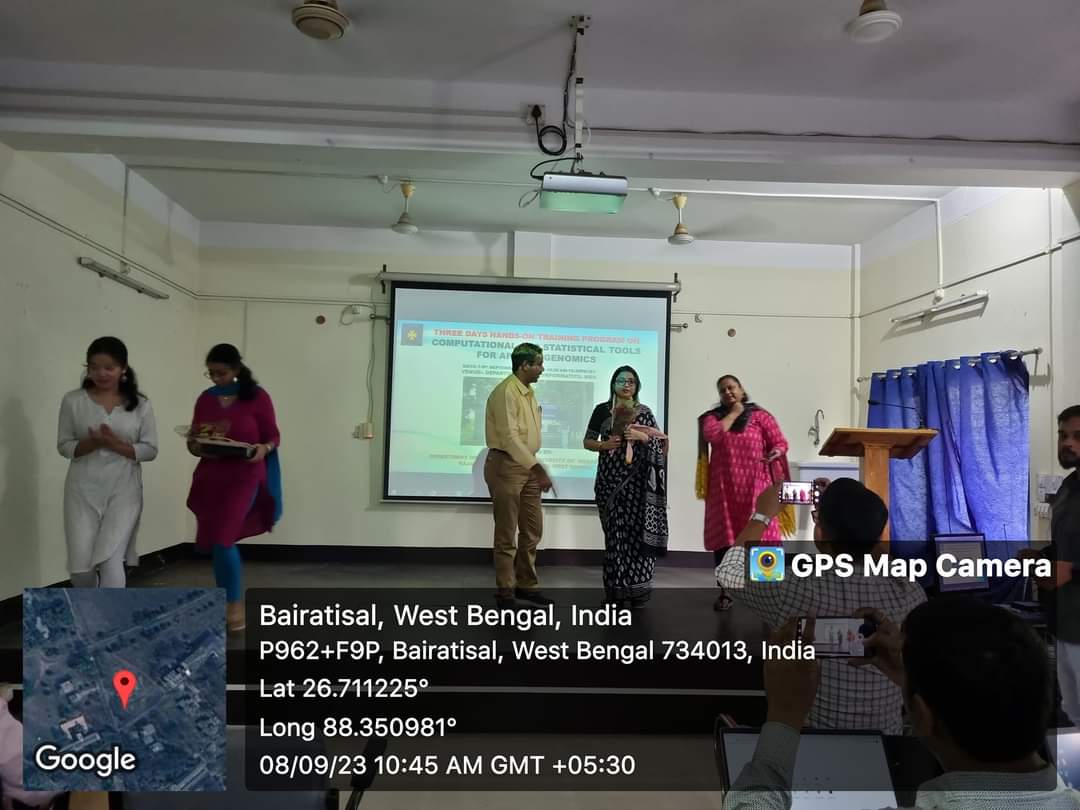
Congratulations to Dr. Rachana Banerjee (Assistant Professor, Centre for Health Science and Technology) for her contribution as a resource person in the Department of Bioinformatics at North Bengal University, providing assistance during the “Hands-on training on computational and statistical tools in applied genomics”. Topic of her talk and training: Present challenges and comprehensive analysis of varied microbiome data Date: 8th September, 2023 Venue: Department of Bioinformatics, NBU Sincere gratitude to Dr. Subarna Thakur (Assistant Professor, Department of Bioinformatics, NBU) and Dr. Georrge J. John (Associate Professor & Head, Department of Bioinformatics, NBU), for extending the invitation.

Events

SERB Sponsored Workshop on “Recent Trends in Functional Materials”

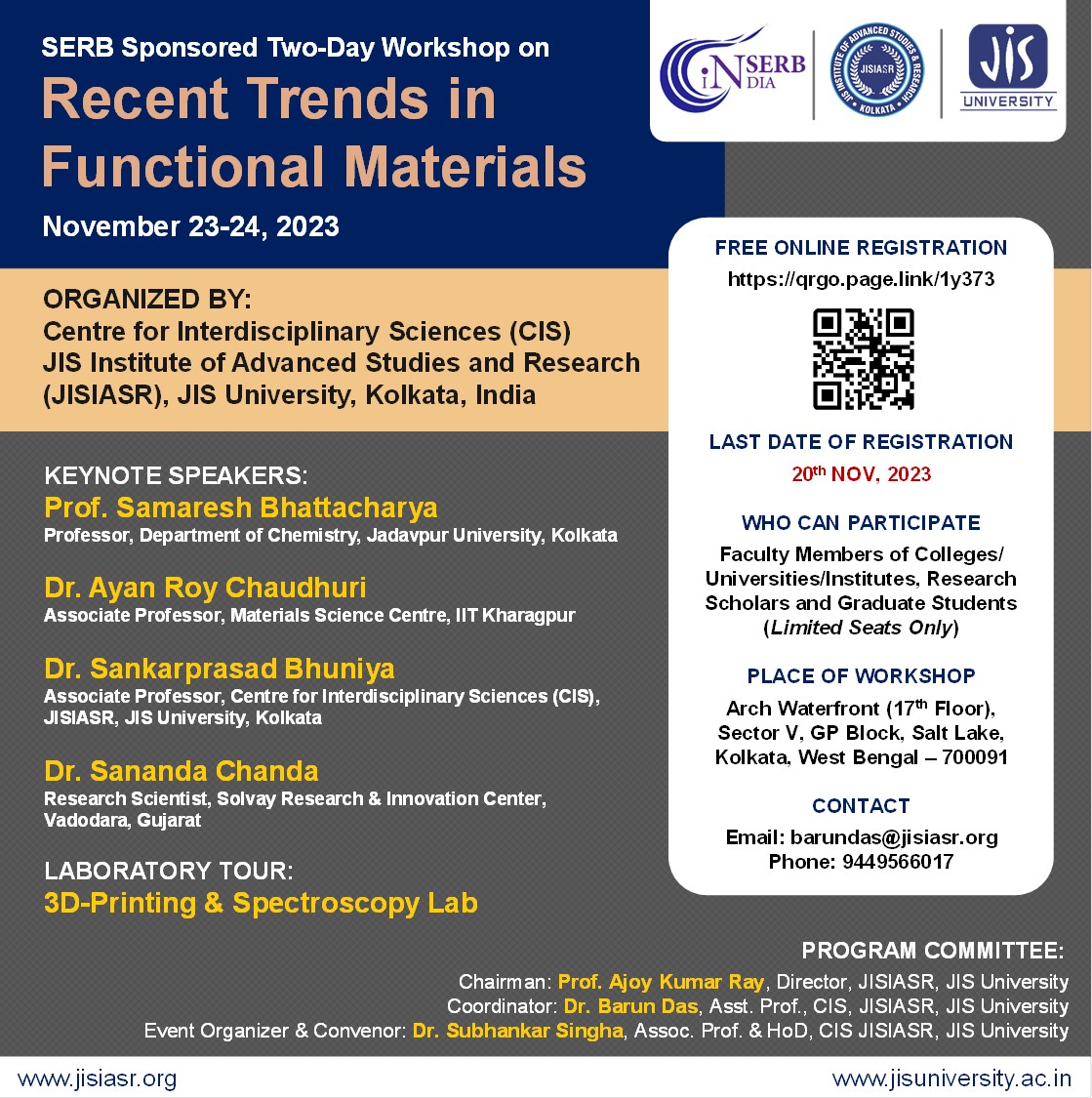
Centre for Interdisciplinary Sciences (CIS) of JIS Institute of Advanced Studies and Research (JISIASR) (www.jisiasr.org), JIS University is organizing a SERB Sponsored Two-Day Workshop on “Recent Trends in Functional Materials” onNovember 23-24, 2023. The participants will have an exposure on following topics: • Organometallic Chemistry and Applications • Functional Nanomaterials and Applications • Spectroscopy and Bioimaging • Sensing and Theranostics • Speciality Polymers • 3D-Bioprinting # Faculty Members of Colleges/Universities/Institutes, PhD/Research Scholars and Graduate Students (Limited Seats Only)can participate in this workshop. # The registration to attend the workshop is FREE. The seats are limited and subject to selection by the program committee. # Registration link:https://qrgo.page.link/1y373 Registration deadline: November20, 2023 (Upon registration, your participation is subjected to selection by the program committee. Your participation will be confirmed through official email from the organizer.) P.S.: Certificate will be issued on successful participation.

Research

3D bioprinting for artificial skin/ organ using tissue engineering

In this project (funded by SERB), the fabrication of structurally modified scaffold with biocompatible polymer materials such as chitosan, cellulose, and hyaluronic acid iselectrospunfollowed by bioprintedto guide cell polarization and migration, through which epidermal wound healing may get accelerated. This technology may open up a new possibilities for artificial organ/ skin printing.

Research

Smart Sensors & Advanced Materials:

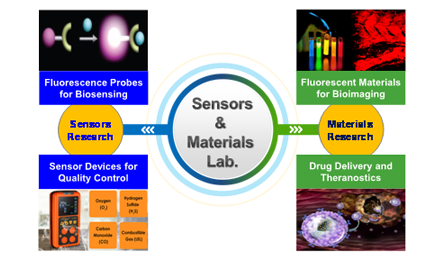
A summary of the targeted research in the “Sensors & Materials Laboratory” is shown in the below diagram by mentioning the associated ongoing researches. It covered the basic research on biosensing and bioimaging through the development of 1) Fluorescent Sensors/Probes for Biosensing, and 2) Fluorescent Materials for Bioimaging. Those basic researches on sensing and imaging materials are currently using for the application oriented research towards- 3) Development of sensor device for quality control of environmental samples, and 4) Drug Delivery and Theranostics for Cancer. In short, the research in this group is mainly focused on the development of novel fluorescent sensing materials and probes/sensors/assay kits, and their application for bio-sensing and patho-biological analysis, as well as innovation of sensor technology (in combination with electronics and IoT) for global sustainability.

Research

Designing Novel Therapeutic Agents for Amyloid Aggregation Process & Novel Nanoparticulate Systems for Drug Delivery

Protein fibrillation, which has caused a number of diseases and is a hindrance to the biopharmaceutics and protein industries, has emerged as one of the significant issues in the biomedical sector over the past few decades.  Numerous substances, including flavonoids, surfactants, nanoparticles, and micelles, have been widely used as hopeful therapeutic agents to treat amyloidogenic disorders like Alzheimer’s, Parkinson’s, Huntington’s, type 2 diabetes, etc. Membrane disruption, organ malfunction, and apoptosis are all caused by the oxidative damage that fibrillar aggregate deposition causes to cellular membranes. Therefore, it is essential to discover new substances that can block the process of protein fibrillation. Here, our main goal is to create brand-new therapeutics that could revolutionise the way we treat neurodegenerative diseases caused by aggregation. We believe that a thorough understanding of the way in which therapeutic medicines interact with amyloid aggregates at various phases of fibrillation will contribute to a better understanding of the aggregation process’s mechanism. This can be used as a powerful design tool to create brand-new inhibitors that are powerful enough to effectively treat neurodegenerative conditions and advance our understanding of protein aggregation. Our another major research interest is in the field of nanomaterials & drug delivery. The low water solubility and poor bioavailability of certain phenolic chemicals, such as flavonoids, terpenoids, and their metal complexes, limits their use in the biomedical area. The stability and bioavailability of these substances will be improved by encapsulating them in protein- and polymer-based nanoparticulate systems. The creation of innovative nano-formulations is anticipated to offer an efficient means of delivering flavonoids and flavonoid-metal complexes to the desired target site and enhancing their antibacterial and anticancer capabilities. This type of delivery technology benefits from efficient encapsulation, controlled release, precise targeting, and biodegradable characteristics. It will be possible to learn more about medication distribution by seeing how synthesized nano-formulations interact with lipids, nucleic acids, or serum albumins.

Research

Structure-property-co-relationship of Graphene-based composite materials for energy research:

Graphene, the two-dimensional (2D) nano-allotropes of carbon consisting of single-layer of sp2 carbon atoms have drawn tremendous attention in academic as well as industrial R & D in last more than one decade or so; due to its’ unique properties such as high surface area, excellent electrical conductivity, superior thermal & mechanical strength and related properties. Interestingly, in recent days assembly of 2D graphene sheets into high-surface area hollow spheres has drawn again significant attraction of this wonder material due to its’ potential eligibility in the broader application areas ranging from catalyst support to drug-delivery and specially major emphasis in the field of energy storage where fabricating electrode materials with graphene for energy storage devices such as super capacitors and batteries has become a major thrust in this research area and great amount of attentions have been employed in this particular research field is also on the possibility of assembly of 2D graphene sheets into hollow spheres for developing core/shell structure composites also for this particular applications. In this proposed research plan; micro-structural, functional aspects as well as potential usage of these Graphene-based composite materials in energy storage devices will be explored in great details.

Scroll to Top